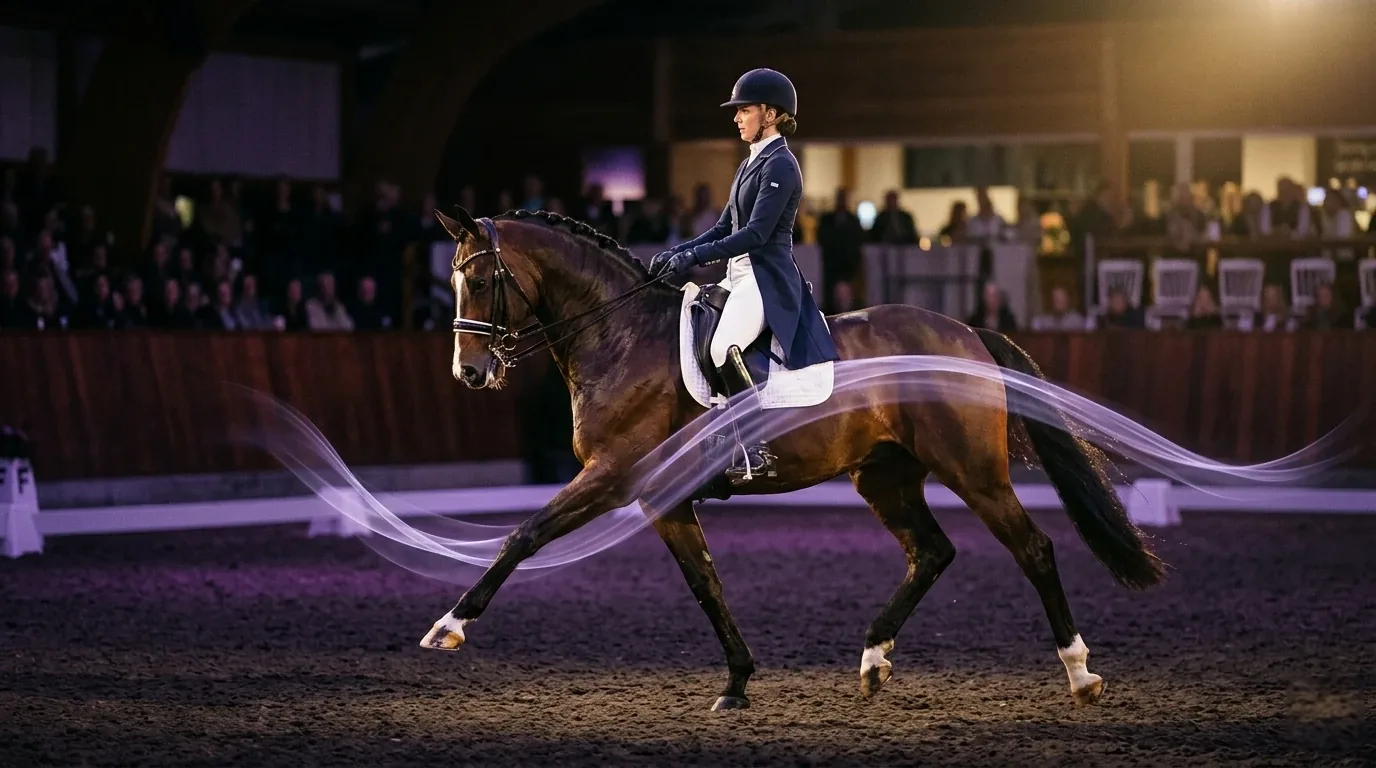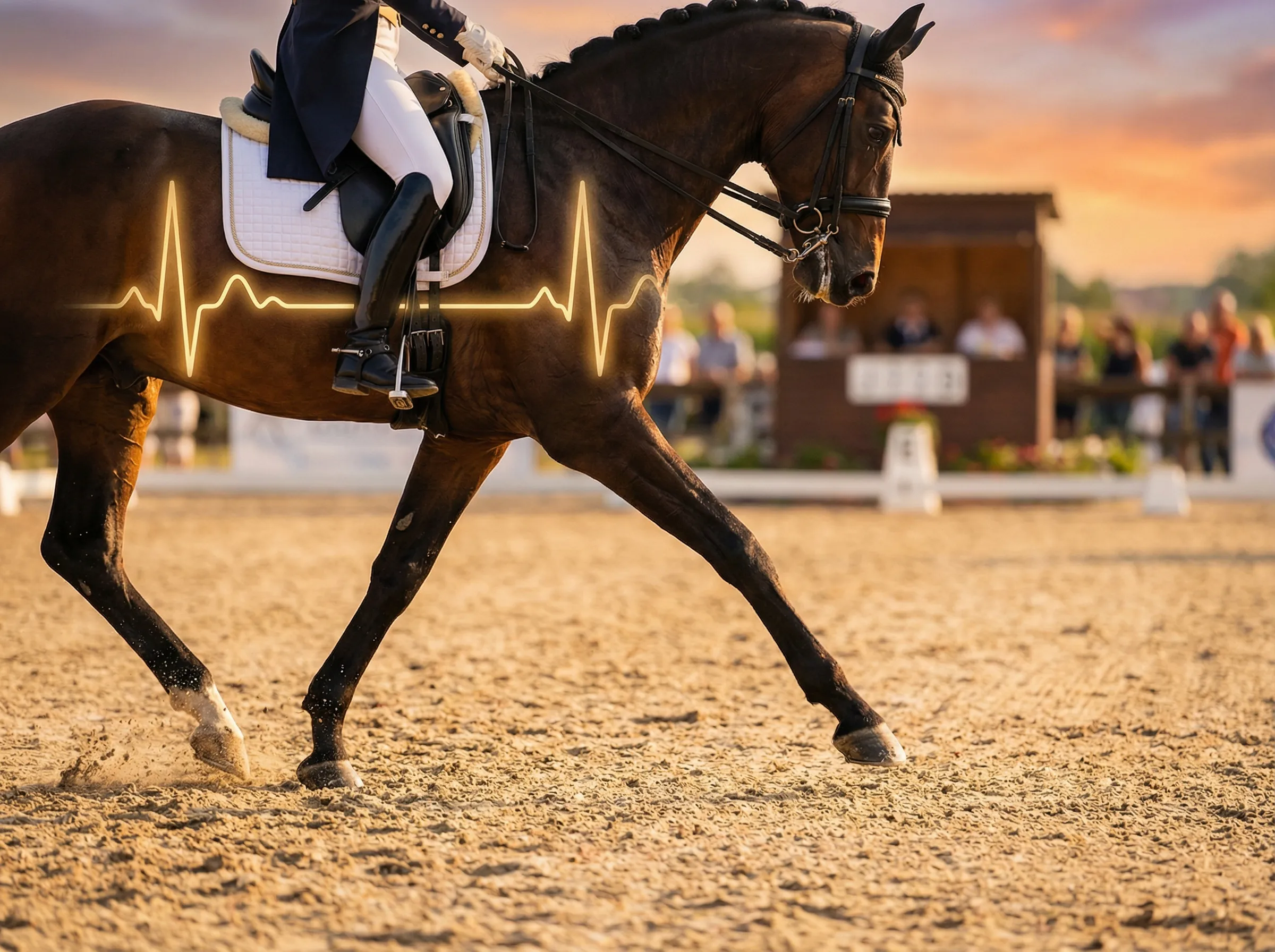
Every dressage freestyle begins with one number: your horse's BPM.
BPM stands for Beats Per Minute. It's the tempo of your horse's stride at each gait. Get this right and the music feels like it was made for your horse. Get it wrong and even the best track in the world will feel "off" to the judges, and to you in the saddle.
The problem? Most riders either guess, use a generic metronome that wasn't designed for horses, or spend hours with a stopwatch trying to figure it out. There's a much better way.
What is BPM and why does it matter for freestyle?
In dressage freestyle, your music needs to match the rhythm of your horse's movement. Judges score this in the artistic marks, and it's one of the first things they notice.
Each gait has its own tempo:
- Walk is typically between 55–65 BPM. Four-beat gait, count one leg each time it hits the ground.
- Trot ranges from about 70–80 BPM. Two-beat diagonal gait, you count one diagonal, not both, so 70 BPM, not 140.
- Canter usually falls between 95–110 BPM. Three-beat gait, count the leading leg.
- Passage (for advanced levels) is slower, typically 58–68 BPM. That slow, elevated trot.
These are ranges, not rules. Every horse is different. A big-moving Warmblood will have a different natural tempo than a quick Iberian or a compact pony. That's exactly why you need to measure your specific horse.
Why generic metronomes don't work for horses
Most BPM tools and metronome apps are built for musicians. They give you a steady click at whatever tempo you set, every beat sounds the same. But horses don't move like that.
A trot has two beats, but they're not equal. One is stronger (the diagonal you're counting) and one is lighter. A canter has three distinct beats with different weight, and a moment of suspension. If you use a generic metronome, you're hearing a flat click-click-click that doesn't reflect how the gait actually sounds and feels.
The DressageTunes BPM tool is built specifically for horses. When you select "Trot," you hear two beats, one stronger, one lighter, just like the gait actually sounds. The BPM shows the real equestrian tempo (70 BPM, not the musical 140), because that's how riders, trainers, and freestyle editors actually work with stride data. Same for walk, canter, and passage. Each pace sounds like the pace.
The most important rule: measure in competition, not just at home
This is something many riders miss, and it makes a huge difference.
Your horse moves differently at a show than in training. The atmosphere, the crowd, the other horses, all of this changes their energy and tempo. In training your horse is in schooling mode, relaxed, familiar with the environment. In competition, they're typically more excited, more "on," performing at a higher level. The BPM changes.
Since you're building a freestyle for competition, you need your competition BPM, not your schooling BPM.
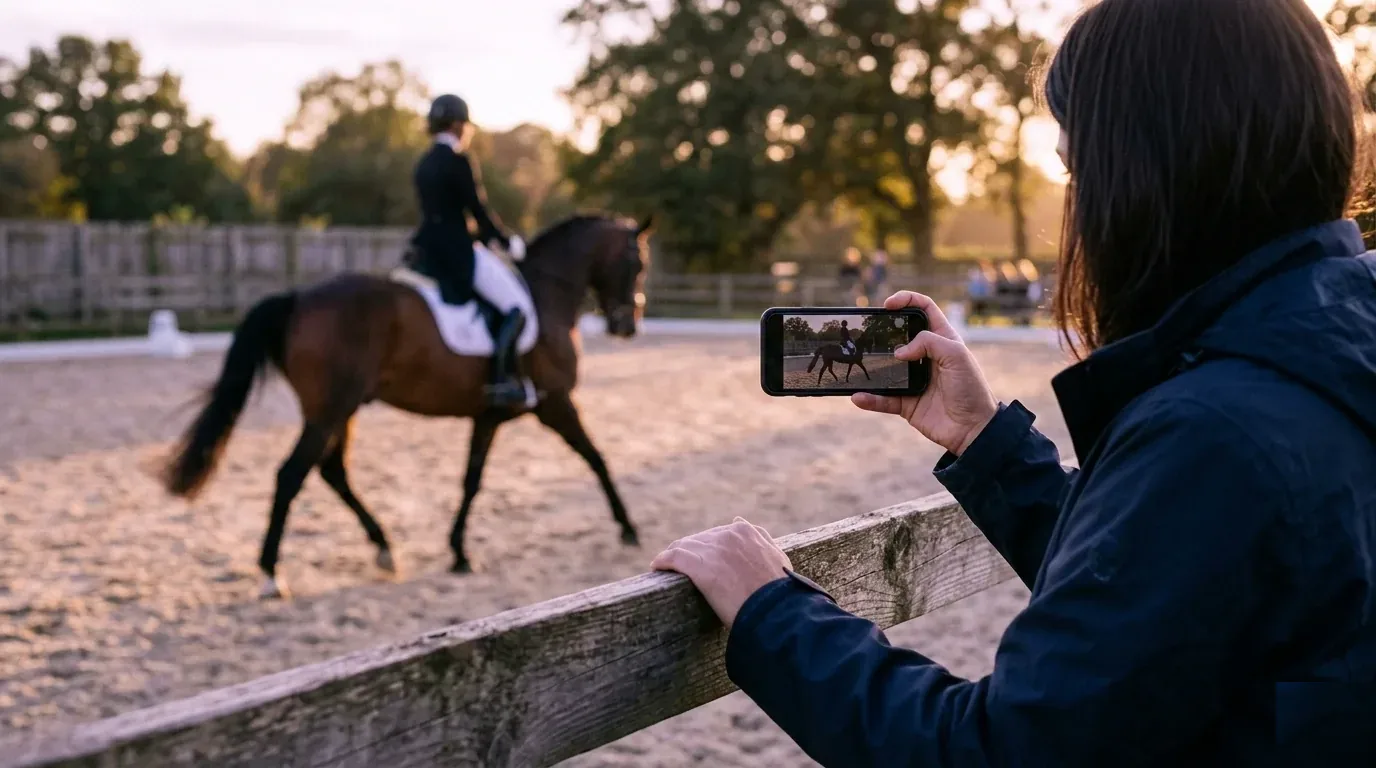
The best approach: take a video of your horse at a show, ideally during a test in a competition setting, and use that footage to find your BPM. You can also use the tool on your phone right at the arena.
Get the best, most natural movement. The part where your horse is moving in their truest rhythm. Not the first stride after a transition, not an extended or collected variation (unless that's specifically what you're building music for). The most natural, flowing movement is what you want, because that's the tempo the judges will hear throughout your test.
How to measure your horse's BPM, step by step
1. Get competition footage (or go live at a show)
Film your horse at a competition, or plan to use the BPM tool live during warm-up at a show. You need a clear view of the legs, side-on footage works best. Film at least 20–30 seconds of each gait in a steady, working rhythm.
2. Set up the tool
Open the DressageTunes BPM tool and select your horse type and level. This determines which paces you need. Intro level shows walk and trot, advanced levels (Inter II and up) add passage. Pick the pace you want to start with.
3. Find the BPM, two methods that work
Method A, slide to match (recommended): Press play so you hear the pace-specific metronome, then slide the tempo slider until what you hear matches what you see on screen (or in front of you at the arena). Once you're close, use the + and − arrows to fine-tune by 1 BPM at a time. When the metronome beats land exactly with the hoofbeats, you've found it.
Method B, tap along: Press play and tap the button in rhythm with one leg hitting the ground. The tool calculates your BPM in real-time. This works especially well when you're watching live.
Both methods work. From experience, the slide-to-match approach tends to be more precise, especially on a first attempt.
4. Repeat for each gait
Set the BPM for every pace your level requires. The tool saves each one, so by the end you have a complete BPM profile for your horse.
5. Take your BPMs to the music library
Once you've set all your BPMs, the tool lets you carry them straight into the DressageTunes music library, where tracks are automatically filtered to match your horse's specific stride tempo.
Why BPM precision matters, the 10% rule
Here's something most riders don't realize: there's a limit to how much you can adjust a track's tempo before it starts sounding unnatural.
In the DressageTunes library, we use a 10% BPM tolerance for matching. That means if your horse canters at 100 BPM, tracks between roughly 90–110 BPM will work well. Push beyond that range and the music starts to sound distorted. Vocals get weird, instruments lose their character, the energy shifts. Sometimes up to 15% can still sound good depending on the track, but 10% is the safe zone where the music stays true to itself.
This is why "close enough" isn't good enough when measuring your BPM. A 5 BPM error in your measurement means you might select a track that needs to be stretched beyond what sounds natural. The more accurate your BPM, the better your music options, and the better your final freestyle will sound.
Common mistakes to avoid
- Measuring only in training. Your horse has a different character at a show. We recommend using competition footage or measuring live at an event. That saves another round of BPM adjustments later.
- Using someone else's numbers. "The average canter is 100 BPM" is meaningless for your horse. Measure yours specifically.
- Using a generic metronome. A flat click doesn't match how a horse moves. Use a tool that sounds like the actual gait.
- Measuring close to transitions. Count the middle of the movement, when your horse is settled in the gait. The tempo should stay the same during all exercises in that gait, but often horses slow down before downward transitions or speed up before upward transitions.
- Only measuring once. Your horse's natural tempo can vary as they develop and change fitness. Re-measure before any new freestyle project, ideally from fresh competition footage.
Once you have your BPM, then what?
With your horse's exact BPM in hand, you can search for music that actually fits. Not music you hope will work, but tracks that are mathematically matched to your horse's stride within that clean 10% range.
The DressageTunes music library has over 500 tracks, all tagged with BPM data. You can filter by gait, energy level, genre, mood, instruments, and more. The library automatically highlights which tracks match your horse's specific tempo, so you're only browsing music that will actually work.
Whether you build your own freestyle or work with a professional editor, knowing your exact competition BPM is the essential first step. Everything else — music selection, timing, transitions, that perfect final halt — builds on this foundation.
Need help putting it all together? DressageTunes also offers professional freestyle music editing with over 10 years of experience and hundreds of tests custom built for riders worldwide.