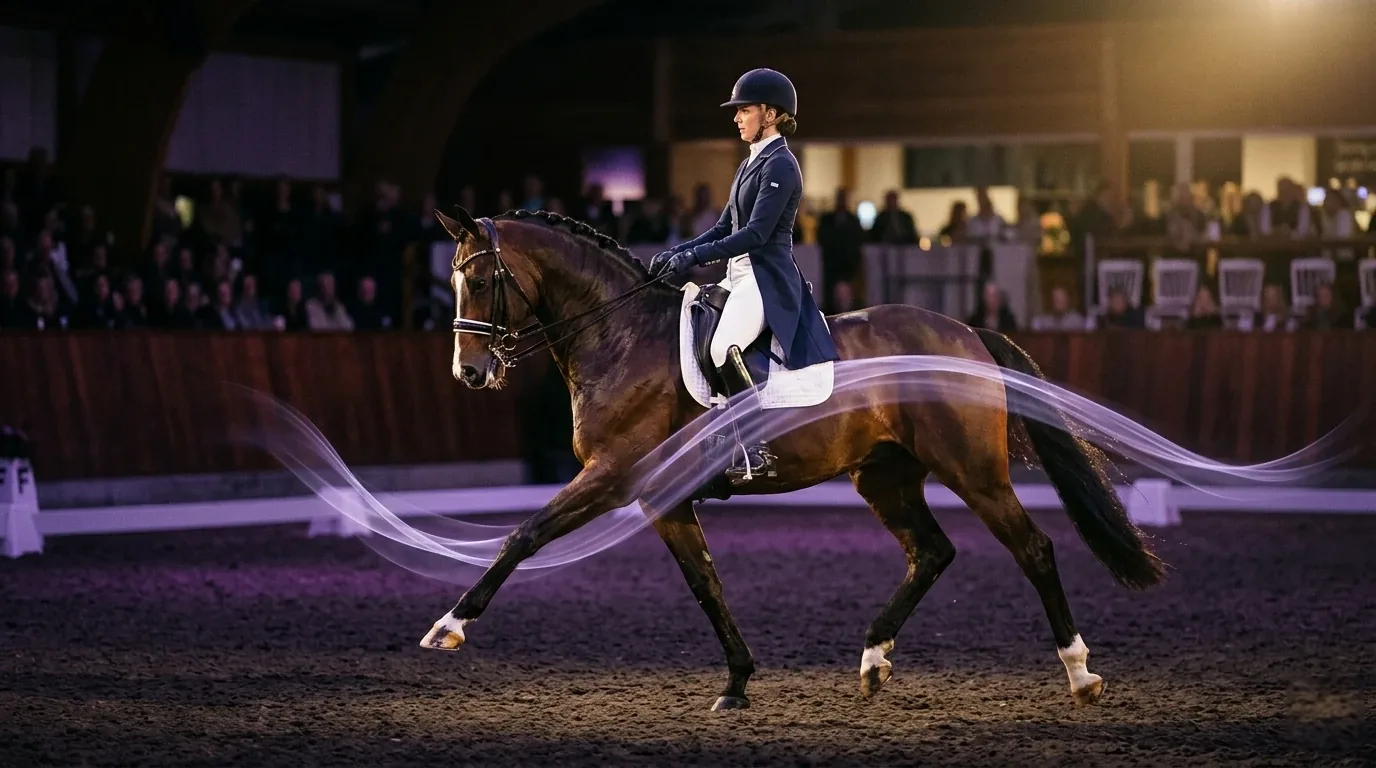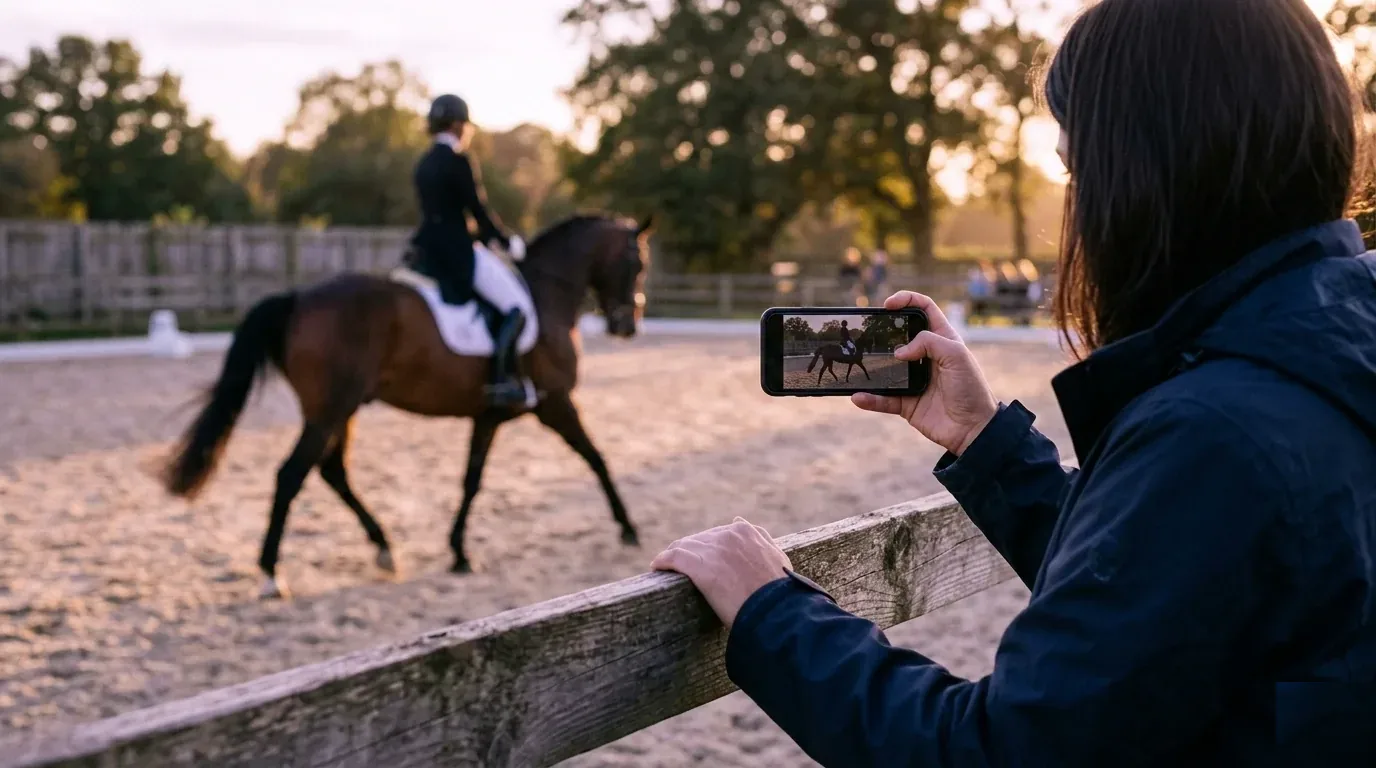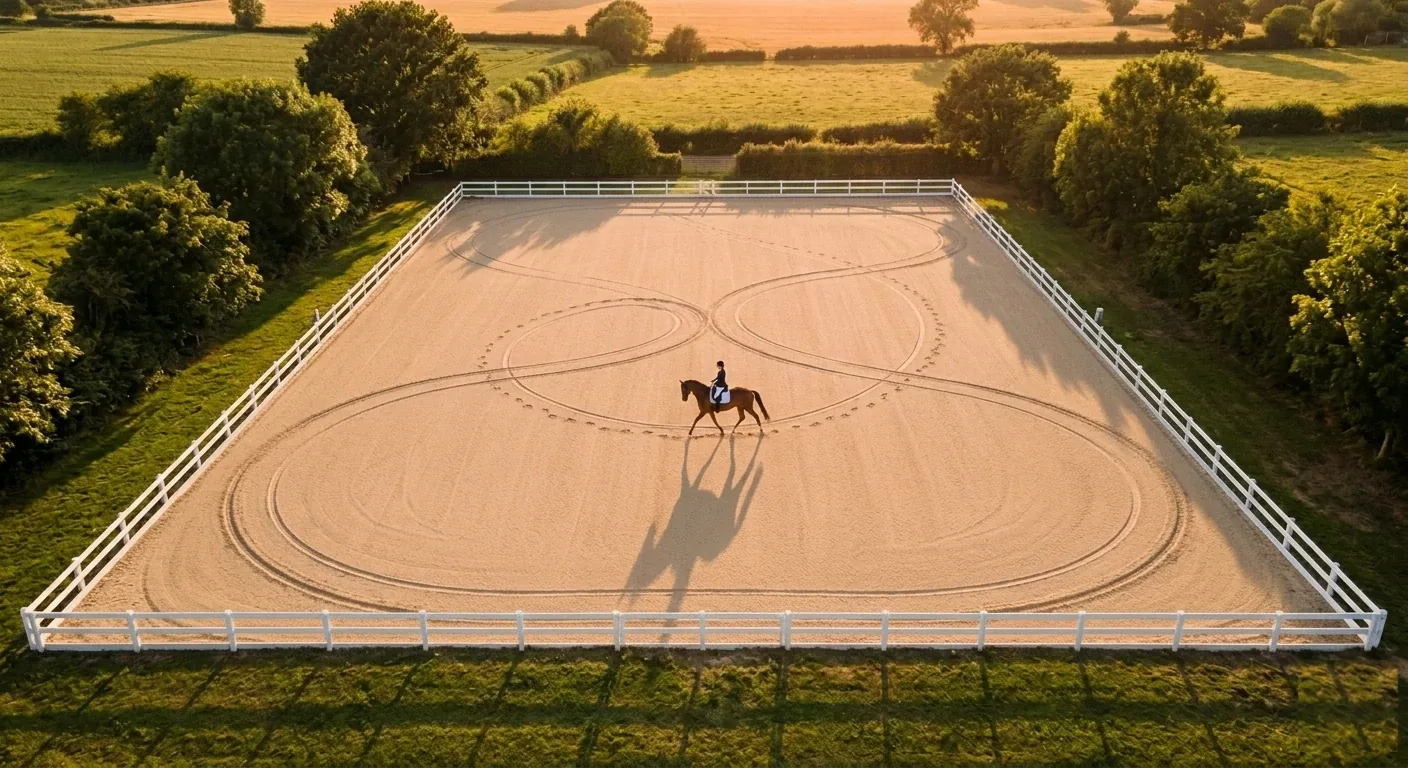
A set test asks every horse the same questions in the same place. A freestyle hands you the arena and lets you decide where everything happens. That freedom is the whole game.
Your choreography, what some riders and judges also call the floor plan, is the path you draw on the arena: the order of your movements and the lines you ride them on. The two words mean the same thing, and we will stick with choreography from here. It is the one part of a freestyle that is entirely yours to design, and it is the part the music is built around. Riders pour their energy into picking a song and worry about the choreography last. It should be the other way around. Get the choreography right and everything else has a frame to sit in. Get it wrong and no amount of good music saves it.
Here is how to build one that suits your horse and works with the judge, not against.
Start from the horse, not the diagram or the song
The most common mistake is designing the choreography in the abstract, a pretty pattern on paper, and only then trying to ride it. Start the other way. Start from your horse.
The reason a freestyle can outscore a set test is that you choose where every movement happens. So put your horse's best work where the judge is looking, down the centerline, toward C, in the open, and tuck the shakier work into the corners and transitions where the eye lingers less. A choreography lives or dies on playing to exactly what your horse does well and quietly steering around what it does not. Before you draw a single line, be honest about both: where is the horse brilliant, where is it weak, what looks better on the left rein than the right.
This is also why most riders build the choreography with their trainer, and why we recommend it. Your trainer knows your horse better than any diagram does. Design it together with the person who can see where the strengths are, and the pattern almost builds itself. We can also design it for you, as an add-on to your music edit, built from the strengths, weaknesses and notes you send us, it is one of our services, but it always starts from the same place: this horse, on this day, at this level.
Know the rules that frame your canvas
A freestyle is free, but not unlimited. Before you sketch, three rules set the edges of the page. Break them and the penalties are real, so they shape the design from the start.
You must include your level's movements. A freestyle has to contain the compulsory movements of the level you enter. You pick the order and the lines, but not whether a movement appears. Leave a required one out and it costs you: under FEI rules an omitted compulsory movement scores a zero and caps both your choreography and your difficulty marks at 5.5, and under USDF rules the missing element scores zero. So step one of any choreography is a checklist of what your level requires, and a confirmation that every item is in there. And check the dimensions, not just that the movement appears: if your level asks for a stretch of extended walk over a set distance, give it the full length. Clipping a required movement short to buy time is an easy way to drop marks you never needed to lose.
You must not ride above your level. This one surprises people: showing a harder movement does not impress the judge, it penalises you. A movement that only appears in tests above your level earns no credit and triggers a deduction, FEI gives it no technical mark and caps your choreography and difficulty at 5.5, USDF docks four points off your technical total for each illegal movement. The simple rule the other way round: anything ridden in the standard tests at your level, or below it, is fair game. If a movement appears on a normal test sheet for your level, you can use it, anywhere you like. One-tempi changes, piaffe and passage are above Intermediate I, for example. Build to your level, not past it.
Mind the arena and the clock. Freestyles are ridden in the standard 20 by 60 metre arena. Time limits vary by level and federation, so the one source that matters is your own test sheet, but as a feel for it: USDF national freestyles (Training through Fourth) allow a five-minute maximum with no minimum, and going over costs a point off the artistic score, while the FEI Grand Prix Freestyle runs between 5:30 and 6:00 with a deduction for over or under. Timing usually runs from the moment the horse moves off after your opening halt to the final halt, so your entry and that first halt are not on the clock, it is effectively halt to halt. Design with a stopwatch, not a guess.
Difficulty is a calculated risk, not a dare
Every rider wants the choreography to look impressive, and difficulty is part of the score. But here is the part most people get wrong: difficulty only pays when you ride it cleanly. The rules are explicit about it. The judge rewards a "well-calculated risk," difficulty that matches the training of you and your horse. Show high difficulty and make a mistake, and not only the difficulty mark but the harmony mark comes down too. Over-ask the horse and it reads as a badly calculated risk, and the difficulty score is reduced for it.
Put plainly: a clean, honest choreography beats an ambitious messy one. As a rough feel for how it scores, meeting just the minimum requirements sits around the low-to-mid sixes, and lifting the difficulty up toward what the standard test at your level asks is what earns a seven and up, but only when the quality holds. Do not buy difficulty you cannot ride. And the honest test is the show, not the schooling ring: if you cannot land it reliably under pressure on the day, leave it out of the plan, however well it goes at home. Spend difficulty where the horse is strong and stay honest everywhere else.
The legitimate ways to make it harder
When your horse genuinely can carry more, the rules even tell you how difficulty is earned. The recognised ways to raise it, each only when ridden correctly, are worth knowing because they shape good design:
- Ride off the rail. Movements on the centre line, quarter line or inner track, on angled or curved lines, are harder than the same movement propped up by the wall.
- Steepen the angles. A half-pass at a steeper angle than the test asks, sometimes with a change of direction, raises the bar.
- Place movements where they are harder. Directly in front of the rail, or a pirouette turned outward toward the spectators rather than inward.
- Use demanding transitions. Piaffe or passage straight out of halt, walk or halt directly into flying changes, extended trot straight into piaffe. Transitions are where difficulty quietly lives.
- Build clean combinations, and repeat your high-value movements only where it genuinely adds, not to pad.
Notice the through-line: difficulty comes from how and where you place a movement, not from sneaking in a harder one. That is exactly the room a choreography gives you.
Repeating a movement does not earn extra credit
This is the single most useful scoring fact for designing a choreography, and most riders have it backwards. When you perform a movement more than once, each time is marked, and those marks are averaged into one score for that movement. So repeating your favourite movement five times does not multiply the points, it just gives the judge five chances to average. A strong first pass and a tired third pass average out lower than the first alone. And cramming the test with repeats can pull your choreography mark down for being repetitive.
The takeaway for design is clean: show a strength once or twice, where it looks its absolute best, then move on. Let the choreography breathe.
What judges actually reward in a choreography
Beyond the hard rules, there is a clear consensus among judges and freestyle designers about what a strong choreography looks like. These are conventions, not regulations, but they are what the choreography mark is built to reward:
- Use the whole arena, end to end and side to side. Dead corners and a choreography that hugs one half of the school read as timid.
- Balance left and right. Show your movements on both reins. A pattern that lives on the horse's good side is an obvious tell.
- Keep the lines clear. The judge should be able to read the pattern. Clever is good, confusing is not.
- Let it flow. Smooth, logical transitions between movements matter as much as the movements themselves.
- Put the showpiece where the judges sit. Your best work, presented toward C, in the open, where it is seen.
One practical detail drives a lot of these choices: where the judge actually is. At most shows there is a single judge at C, looking straight up the centerline, and at bigger ones a second at B or E. So your best work wants to face C, presented toward the judge rather than ridden away with the horse's back to them, and the movements you are less sure of can sit where the angle from C is least revealing. Use the judge's eyeline as part of the design, it is one of the biggest advantages a freestyle hands you over a set test.
Plan a safety line
Here is a pro habit worth building in from the start: a safety line. Because a freestyle lets you choose where everything happens, you can design a spot where, if a movement goes wrong, you have a planned way to come back round and present it again to rescue the mark, instead of improvising in a panic. It pairs neatly with how repeats are scored, a clean second attempt averages with a scrappy first and saves the score. You hope never to use it, but a choreography with a built-in escape route is calmer to ride, and a calm ride scores better than a flustered one.
The choreography and the music are two halves of one thing
A choreography is not finished until the music is built to it, and the order matters: the shape comes first. The music is timed to land on your movements, so the big extension, the pirouette, the final halt on the centerline, the accents fall where the choreography puts them, not the other way around. Lock the choreography, or at least its broad structure, and the music can hit a musical accent on the halt and lift under the canter work. That is the whole idea behind a freestyle that feels right: what you hear matches what you see.
You do not need to know your horse's tempo to start designing, that is our job, but it is what the music is built on. There is a full walkthrough in the BPM guide, and the craft of matching the music to the horse is its own piece, how to choose your freestyle music. For the choreography, the rule is simple: build the shape so the music has something to dance to.
And think of the whole thing as a story the choreography and the music tell together, one that has to make sense. A practical example: each pace has its own sound, so a test chopped into too many transitions fragments the music, the sound never settles and the picture never reads. Give each pace room to breathe, a clear stretch of walk, of trot, of canter, so the judge and the audience can actually watch it. A choreography that switches gait every few strides can feel busy and clever, but it rarely looks or sounds good. The strongest freestyles say one clear thing, they do not shout over themselves.
How to build one, step by step
Here is the order we use, and the one we recommend to riders building their own.
- Get your actual test. Pull the official test sheet for your level. It already lists every compulsory movement, the arena size, and the time limit, halt to halt. Work from the sheet, not from memory, that is the box everything has to fit in.
- Map your horse. Honestly note the strengths to feature and the weaknesses to hide, and which movements look better on which rein. This map drives every choice that follows.
- Draw it, do not just imagine it. Map the flow on a printed blank arena or an online arena tool. Drawing it does two jobs at once: it helps you memorise the test, and it lets you actually see whether you are using the whole arena and covering both reins, which is obvious on paper and invisible in your head. Place your best work toward C and in the open, weaker work where the angle hides it.
- Build in a safety line. Plan one spot where you can re-present a movement if it goes wrong, so a mistake on the day does not cost you the whole mark.
- Ride it, do not just walk it. Walking it through on foot tells you almost nothing, the horse is the only real test. Ride it against the clock: where does it cram, where does the horse lose balance, where does a transition stall. And if it runs over the allowed time, it is back to the drawing board, that is a normal part of the process, not a failure. Refine until it rides easy and lands inside the limit.
- That is it, your choreography is ready for music. The shape is locked, ridden and timed. Building the music is a separate craft that comes after, with every accent built to land where the movement does.
The mistakes that cost riders most
Almost every weak choreography comes down to one of a few things. Over-facing the horse, asking for difficulty the training cannot carry cleanly, which pulls down several marks at once. Cramming, too many movements with no room to breathe. Poor use of the arena, dead corners and a pattern stuck in one half. A lopsided plan that favours the good rein. Pointless repetition that averages the score down and bores the choreography mark. Forgetting a required movement, or sneaking in one above the level, both of which carry hard penalties. And a choreography the music cannot follow, built with no thought to where the accents will fall. None of these are hard to avoid. They just have to be caught on paper, before you are committed.
The short version: your choreography checklist
Do
- Design to your horse, strengths in the open, weaknesses tucked away.
- Include every required movement for your level, and nothing above it.
- Use the whole arena, and show your work on both reins.
- Add difficulty only where the horse can carry it cleanly in a show, not just at home.
- Draw it out on a blank arena, and plan a safety line for anything that might go wrong.
- Lock the shape first, then build the music to it.
Avoid
- Buying difficulty you cannot ride.
- Repeating a movement to pad the score.
- Cramming, or leaving half the arena empty.
- A pattern that only works on the good rein.
- Designing the choreography with no idea where the music lands.
That is the whole of it. A good choreography is honest about the horse, clean about the rules, and built before the music so the two move as one. Want us to design the choreography too? It is an add-on to your music edit, built from the strengths and weaknesses you send, one of our services. You can read the whole ordering checklist first, or just send your video and we will take it from there.